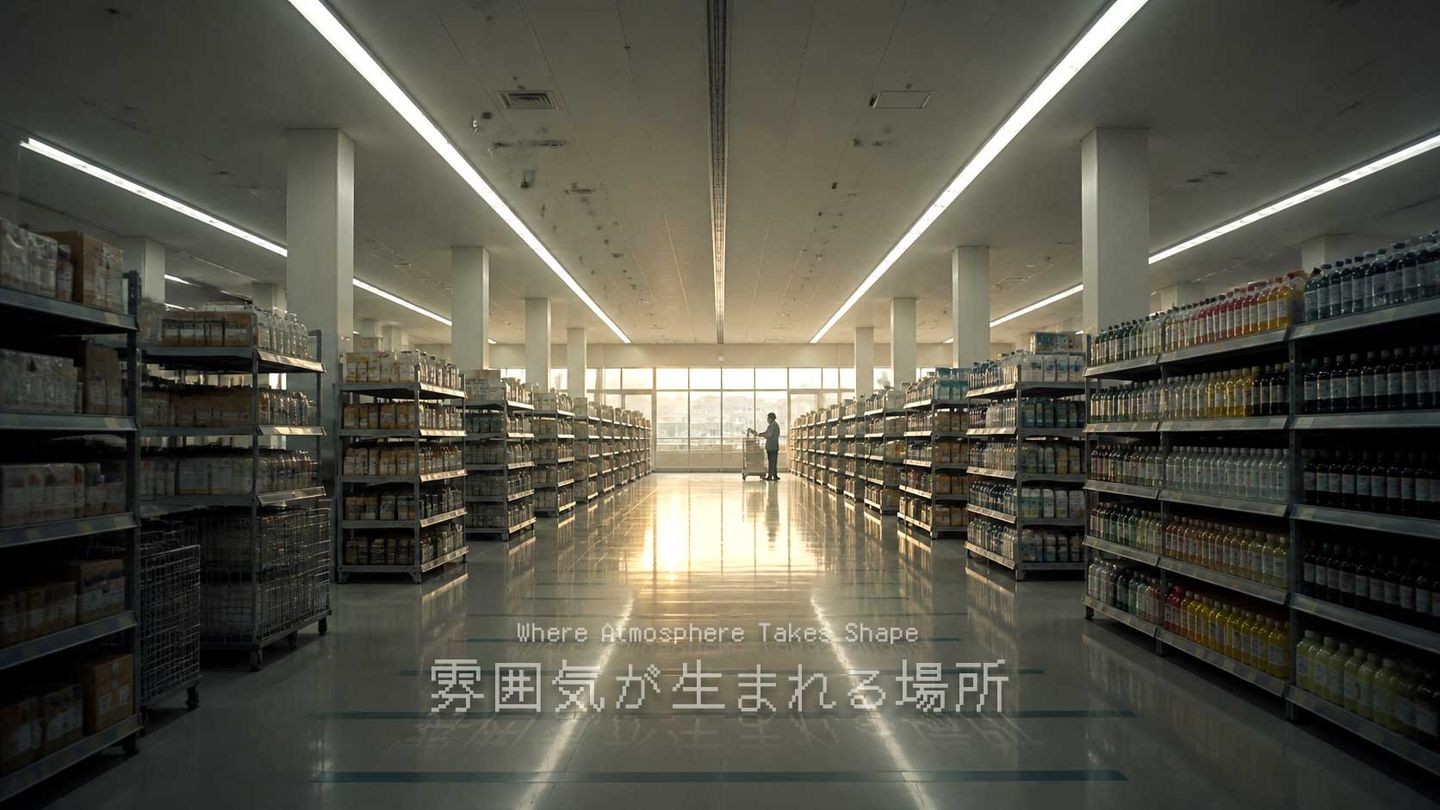
A continuation of the previous article.
This series began as a set of research notes prompted by a question: Why does the atmosphere vary so much from one store to another—mainly supermarkets, other retailers, and restaurants?
Imagine two locations of the same chain.
The signs, the way the products are arranged, and the staff uniforms are all more or less the same. At one location, you can make your way around the sales floor and finish your shopping without anything in particular catching your attention. At the other, little things keep bothering you, and the farther you go, the stranger the place begins to feel.
The head office is supposed to have standardized the interior and the manuals, yet the atmosphere still does not match.
Looking back at what I have investigated so far, a store's atmosphere seems important to both customers and staff. If differences in atmosphere also affect customer behavior and the condition of the store, why do chain headquarters not design the atmosphere just as carefully?
At first, I simply assumed they did not have the capacity to go that far. But the issue is more complicated than that.
How much of an atmosphere can actually be designed? And when we try to design the feel of a place, what are we really designing?
Research Note 1: You Can Design the Conditions, Not the Atmosphere
One idea is that a store's physical environment—lighting, sound, temperature, layout, signs, and so on—affects how not only customers but also the people who work there feel and behave.[1]
There are also design approaches that aim to influence which behaviors are more likely by improving visibility, making entrances and exits intuitively clear, and showing who is responsible for a space.[2]
For example, even if you are there to do the same shopping, a store where you can see someone at a register near the entrance gives a different impression from one where no staff are visible for some time after you walk in. The location of a restroom—tucked away at the back or accessible from outside the store—may also subtly change how people think about using it.
The relationship between the retail environment—stimuli such as music, scent, and color—and customer satisfaction has long been studied. On average, environments with music or scent tend to produce higher levels of pleasure and satisfaction than environments without them.[3]
That makes it seem as though atmosphere can, to some extent, be designed. But what can be designed is not the atmosphere itself. It is some of the conditions that make a certain atmosphere more likely to emerge.
Changing the lighting, widening the aisles, and playing music can give a place a particular feel. But that feeling can easily be overwritten by circumstances that change from moment to moment. All kinds of people arrive, and countless things—the day's crowding, the weather, and much more—affect the atmosphere.
This is not a choice between designing a place and leaving it to chance. I had assumed that a well-designed store could preserve the atmosphere it intended to create. In reality, it may be more accurate to say that even careful design can establish only the starting point for each day.
An atmosphere is not a product completed according to a blueprint. It seems to be created anew each day in the space between the conditions provided and what actually happens there.
Research Note 2: Choosing the Conditions Also Chooses the Behavior You Welcome
Some people find a brightly lit store easy to see and reassuring. Others find it glaring and hard to relax in. Quiet music may be pleasant to one person and pretentious to another.
Luxury-brand stores offer a clear example. Generous empty space, a limited number of products, and quiet service can convey calm and exclusivity. To an ordinary person like me, though, they can make the store feel like somewhere I should not enter without a specific reason. That is not necessarily a failure. It is also the result of the whole space communicating what kind of customer the store welcomes.
Research on retail environments likewise suggests that simply introducing a stimulus—such as a particular color of lighting or a particular arrangement of fixtures—does not automatically produce the same effect. The combination of stimuli and how well they fit the setting also matter.[3]
Shaping an atmosphere does not mean making everyone equally comfortable. It means pointing people in a direction: this is how we would like you to spend your time here.
When that direction is strongly expressed, some people feel reassured while others feel constrained. When it is weak, the store becomes more open to different people, but it also becomes less clear what kind of behavior the place is meant for.
The phrase “make the store feel pleasant” sounds like something everyone would welcome. But once it is translated into concrete design decisions, the store has to choose what kinds of customers it wants and how it wants them to spend their time. Designing an atmosphere also seems to mean deciding what the store will welcome.
Research Note 3: Space Alone Cannot Respond to Disorder During Business Hours
In a study conducted in simulated retail settings, people in a disorderly store were more likely than those in an orderly store to choose behavior that violated the rules.[4]
It would be an overstatement to say that customers will inevitably misbehave in a dirty store. Still, the explanation makes sense to me: small signs of disorder, such as trash on the floor or abandoned shopping carts, do more than make the place look bad. They can also convey that “the rules are not being followed here” and “no one will respond if they are broken.”
It is easy enough to say, “Then just keep the place reasonably orderly.” But what counts as reasonable differs from person to person, so it is not that simple. Designing an atmosphere does not end when the store opens; it continues for as long as the store is operating.
When the intended atmosphere begins to break down, one response that head offices and managers can easily distribute across locations is a sign.
In one study, adding signs that explained where and how to complete procedures in a crowded reception lobby reduced visitors' perceived crowding, discomfort, anger, and confusion, while also shortening the time needed to complete the process.[5]
The signs added in this case did not scold visitors. They told them what to do next. When there is less uncertainty, people can move more calmly.
Some signs give people information that supports their judgment. Others are made to carry the response that should have come from a person.
Recommendations for signs include limiting the content to essential information, checking that the message can be understood, making sure the stated action can actually be taken, and, when necessary, supporting compliance through means other than the sign itself.[6]
If a sign says, “Reception is this way,” the person reading it can move on to the next step. But if it merely says, “Please refrain from disruptive behavior,” it remains unclear what has happened and how the store will actually respond.
Research Note 4: People Cannot Be Copied
There are many things a chain can distribute in common to all its locations.
Signs, fixtures, uniforms, manuals, cleaning procedures, templates for notices. Anything tangible or reducible to written instructions is relatively easy to copy.
But situational judgments and responses—noticing a small irregularity, choosing the right way to approach someone, or encouraging a change in behavior without provoking them—cannot be copied in the same way.
A problem may grow while someone is still deciding whether to speak up. A staff member who tries to act early may be seen as interfering unnecessarily. The people and circumstances differ every time, so no manual can cover every possible situation.
At the same time, it is unreasonable to leave everything to individuals on the assumption that a few capable employees will take care of it.
In workplaces with adequate staffing and training, where employees can fully engage with their work, an atmosphere that supports good service is more likely to develop. That workplace atmosphere, in turn, improves employee performance and contributes to customers' desire to return.[7]
Employees are human too. No matter how hard someone tries to provide good service on their own, it is difficult to sustain unless they feel that their work is expected, supported, and valued—unless they happen to be some kind of saint.
Even when front-line staff notice a small irregularity, they will probably pretend not to see the next one if speaking up only creates more trouble or gets them blamed by someone above them. Creating an atmosphere therefore seems to require an environment in which staff feel it is safe to respond.
Human judgment itself cannot be copied. But an organization can create the conditions that allow people to feel safe responding. If we are going to design the feel of a place, the scope of that design must extend beyond the interior to the systems that let front-line staff keep responding.
Research Note 5: What Is Hard to See Gets Put Off
I had thought that differences between stores might be so large because atmosphere is subjective and difficult to quantify. Yet there have been many attempts to measure it in different ways.[1][3] Apparently, it is not impossible to express in numbers.
What is difficult is isolating atmosphere itself as a single number.
If we tried to list every factor that affects a store's atmosphere in order to quantify it, the list would be enormous: lighting, sound, the amount of merchandise, crowding, customers' ages and genders, staff, weather, time of day, and so on. Not only are there many factors; they also overlap in complex ways. If sales rise, it is not easy to separate whether the new display worked, the staff seemed calmer, or it just happened to be payday.
Even if subtle differences in atmosphere prevent problems or gradually bring in more regular customers, the effects take time to appear. And if the effort succeeds, the result simply becomes an ordinary day on which nothing happens.
The issue may be less that atmosphere is put off because it cannot be measured than that it is difficult to decide how much of an outcome should count as a return on investment in atmosphere. Seen that way, it becomes easier to understand why businesses might choose visible measures that can be readily distributed to every location—signs and manual templates—over staffing and systems for responding.
Even so, if that difficult decision is left vague, the small disruptions that arise during business hours remain for front-line staff to handle. Trying to design an atmosphere ultimately seems to lead to a difficult question: how many people and how much money should be devoted to things whose effects are hard to see?
Aside: Who Does the Designing?
Choosing the interior and writing manuals are not enough to preserve a store's atmosphere. I suspect the outcome depends greatly on what the people at the top do about the parts that cannot be drawn on a blueprint—and how seriously they think about them.
Every location has different circumstances. Staffing and budgets are limited. Poorly judged intervention may only confuse the people on the ground, while imposing too much order may make some customers feel that the store is “cold” or “exclusionary.”
From the outside, it is easy to say anything you like. Who knows what dramas are unfolding behind the scenes? Truth is stranger than fiction. If I knew the internal circumstances, I might no longer be able to say, “Isn't this just a failure of senior management?” Even so, as one of the people using the place, I am still left with something that bothers me.
How far should the organization support problems that cannot be handled by front-line staff alone? What should be left to individual employees' judgment, and what should the company take responsibility for as policy? If even the decision about where to draw that line is left to the front line, what exactly is head office designing?
The organizations I have personally seen represent only a very narrow slice of the whole. I do not know enough to make sweeping claims about business leaders in general. Even so, deciding how far an organization will support problems that the front line cannot take on alone seems to me an unavoidable part of management's design work.
Is it too much to demand, “If you're going to call yourself a leader, rise above it” (in a suitably dramatic voice)? Then again, if I ever found myself at the top, I would probably think, “Easy for you to say.”
What I Have Learned So Far
Atmosphere is not entirely a matter of chance. We can deliberately create some of the conditions that make a certain atmosphere more likely to emerge: lighting, sound, traffic flow, signs, and so on. But atmosphere is not completed simply by putting those conditions in place.
Choosing the conditions also means showing people how the store wants them to spend their time there. Some will find that direction comfortable; others will find it restrictive. And once the store opens, crowding and trouble begin to alter the conditions that were originally designed.
Even as those conditions change, signs can convey information, employees can respond to situations, and the organization can support those responses. Customers observe all of this and pick up the message: “This seems to be how people behave here.” Only as those interactions repeat does something resembling the store's atmosphere begin to take hold.
Locations in the same chain may differ not only because some are designed and others are not, but because they differ in how well the designed conditions are sustained through small actions repeated every day. Those differences may be what surface as the atmosphere of each store.
Designing the feel of a place is not about specifying the finished state of a physical space. I think it means considering who will notice the gaps that arise during business hours, how they will respond, and who will support that response. What lies beyond the initial design is not only the space itself, but also the people and organization that maintain it each day.
Next Time
Looking into all of this has changed how I see the word “atmosphere.”
A store's atmosphere is not maintained by its interior and its rules alone. It also matters that someone notices a small irregularity, senses that it cannot be left as it is, and responds.
So who takes on this work of “reading” a situation?
When I pull my perspective back from the store, it seems that workplaces, schools, and communities are also sustained by people who read unwritten rules and act on them.
Next time, I will organize my thoughts on the relationship between society and the people who can “read” it.
In This Series
#01 | Where Does a Store's Atmosphere Come From?
#02 | Why Locations of the Same Chain Can Feel So Different
#02.5 | Why Do Stores with Too Many Warning Signs Feel So Disorderly?
#03 | How Much of a Store's Atmosphere Can Be Designed? ← You are here
#04 | Society Assumes People Can “Read the Room”
#05 | Choosing to Keep Your Distance
#06 | How Quiet People Survive
Notes
- Back to text
Mary Jo Bitner, “Servicescapes: The Impact of Physical Surroundings on Customers and Employees,” Journal of Marketing, 56(2), 1992, pp. 57–71. https://doi.org/10.1177/002224299205600205
- Back to text
National Institute of Justice, Resource Manual on Crime Prevention Through Environmental Design. https://nij.ojp.gov/library/publications/resource-manual-crime-prevention-through-environmental-design
- Back to text
Holger Roschk, Sandra Maria Correia Loureiro, Jan Breitsohl, “Calibrating 30 Years of Experimental Research: A Meta-Analysis of the Atmospheric Effects of Music, Scent, and Color,” Journal of Retailing, 93(2), 2017, pp. 228–240. https://doi.org/10.1016/j.jretai.2016.10.001
- Back to text
Saar Bossuyt, Patrick Van Kenhove, Tine De Bock, “A Dirty Store Is a Cost Forever: The Harmful Influence of Disorderly Retail Settings on Unethical Consumer Behavior,” International Journal of Research in Marketing, 33(1), 2016, pp. 225–231. https://doi.org/10.1016/j.ijresmar.2015.12.005
- Back to text
Richard E. Wener, Robert D. Kaminoff, “Improving Environmental Information: Effects of Signs on Perceived Crowding and Behavior,” Environment and Behavior, 15(1), 1983, pp. 3–20. https://doi.org/10.1177/0013916583151001
- Back to text
Mark R. Lehto, David R. Clark, “Warning Signs and Labels in the Workplace,” Advances in Human Factors/Ergonomics, 15, 1991, pp. 303–344. https://doi.org/10.1016/B978-0-444-87441-2.50017-0
- Back to text
Marisa Salanova, Sonia Agut, José María Peiró, “Linking Organizational Resources and Work Engagement to Employee Performance and Customer Loyalty: The Mediation of Service Climate,” Journal of Applied Psychology, 90(6), 2005, pp. 1217–1227. https://doi.org/10.1037/0021-9010.90.6.1217
DID YOU ENJOY THIS ARTICLE?
制作活動を支援する / Support my work
文章、アート、デザイン、個人開発を続けるための支援を、コーヒー一杯分から受け付けています。 / Help me keep making essays, art, design, and independent software.

Information