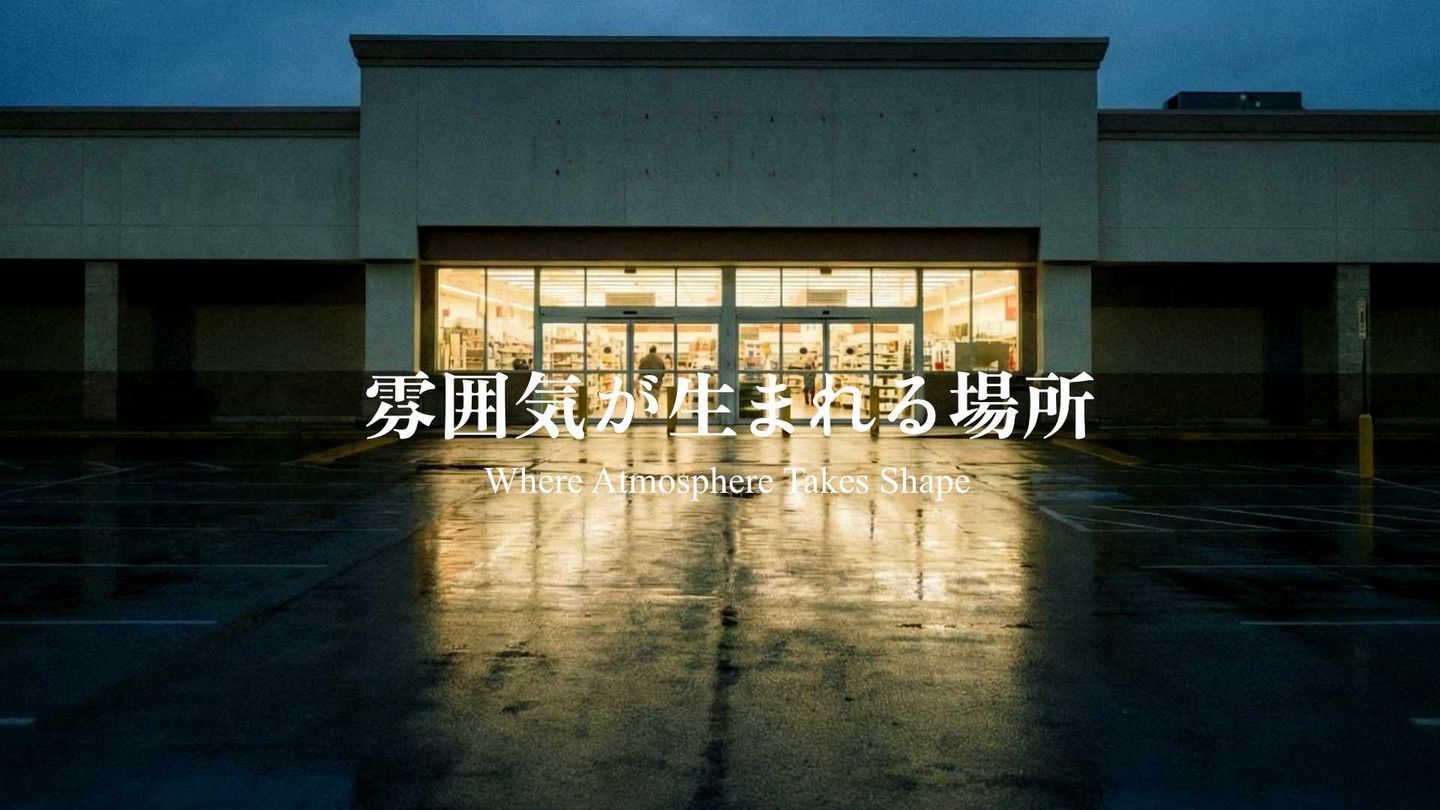
“Why can the atmosphere feel so different from one store to another?”
It is a question I have been wondering about for years, one that occasionally comes back to me when I go shopping.
The stores sell much the same things, and even the buildings are not all that different. And yet, somehow, the clientele—or rather, the vibe of the people shopping there—feels different. The overall feel of the place is off. You cannot quite explain it, but something feels unsettling. It is a subtle, hard-to-pin-down difference.
The area around the restrooms is a mess. The cleaning seems to be falling a little behind. The trash cans have been closed off. Did something happen here? Is poor management on the store’s part the only cause? And yet, that does not seem to explain everything...
I live in a regional area where getting around by car is the norm, so I used to think it might simply be something specific to the neighborhood around each store. But I could never work out what factors were creating that sense of imbalance. Maybe I was just paying far too much attention to it...
Then, the other day, I encountered three alarming customers in a row at a certain supermarket. That finally pushed me to investigate and put this long-standing question to rest.
Research Note 1: The Flow of People You Cannot See from an Address
At first, I assumed that differences between the areas where stores were located would be the main factor.
But there are many ways to draw the boundaries of an “area.” If we divide places by municipality or neighborhood name, we may miss how a store is actually used. Shoppers do not move along the borders of administrative districts. They choose stores within their own everyday routes, connecting roads, stations, workplaces, schools, hospitals, and other destinations.
When estimating a retail store’s catchment area, analysts consider not only simple distance but also factors such as the store’s size and appeal, nearby competitors, and actual shopping patterns to estimate where its customers come from.[1] Even when two stores look similarly situated on a map, they are not necessarily connected to the same flow of people.
For example, a store that draws people from a residential area in the evening will be used differently from a supermarket where drivers on a major road stop only briefly. Near a station or public facility, some people may enter not primarily to shop, but because they are waiting or changing transportation. Along a road that remains busy late at night, the hours during which people use the store will also be more varied.
The more that people doing their everyday shopping mix with people stopping to rest, kill time, or use the restroom, the wider the range of uses the store has to anticipate. Because these different flows of people converge, we cannot simply say that a store is the way it is because it is in a particular neighborhood.
Some of what I had perceived as a store’s “atmosphere” may not have been a characteristic of the store alone. It may also have come from the combination of people passing through the surrounding area and their reasons for staying there.
Research Note 2: How Stores Are Set Up to Be Used, and How Customers Want to Use Them
A store provides more than products. It also provides possibilities for how people can spend time there.
Are the trash cans placed outside or kept only inside? Are the restrooms always available, or closed at certain hours? Are there chairs where people can take a break, or is the space designed simply for customers to shop and leave?
These small choices change how convenient the store is for different people. Differences in convenience can, in turn, affect who keeps using the store.
The idea that the physical environment influences how customers and employees feel and behave is known as the “servicescape.”[2] It is a marketing concept concerned with enhancing the value of a service through elements such as the amount of lighting and the arrangement of fixtures. This does not mean that an environment can control everyone in the same way. The same lighting level or aisle width may feel relaxing to one person and hectic to another.
Even if we have never heard of servicescapes, each store presents us with many small points of judgment: “This place works well for me,” or “Something about this place wears me out.” As those impressions accumulate, the people who continue coming and those who choose another store gradually begin to diverge.
Rather than the store unilaterally selecting its customers, the way the store is set up to be used and the way customers want to use it select one another. “Selecting” makes it sound intentional, though. In reality, it may be closer to an accumulation of tiny conveniences and unconscious preferences: “It is easy to park here,” “I can use the restroom,” or “The staff leave me alone.”
So those alarming people I encountered were wanderers, driven from every other refuge...
Research Note 3: Small Responses Shape What Happens Next
A store’s atmosphere is not determined by its location alone.
A store opens somewhere, and people passing through the area begin to use it. Whether by chance or inevitability, small problems may eventually arise: trash is left behind, the restroom gets dirty, or people linger near the entrance. How the store responds at that point changes how the space will be used next.
The mess is cleaned up right away. Something is moved to a different spot. A staff member quietly speaks to someone. Or perhaps the situation is simply left as it is for a while.
From this accumulation of responses, customers learn “what is normal here.” People sometimes decide how to act by looking both at what others are actually doing and at what those around them appear to expect.[3]
Research has also suggested that disorder in a retail environment may make behavior that departs from social norms more likely.[4] Of course, a single study is not enough to conclude that a dirty store will inevitably make its customers behave worse. Still, it is easy to understand how a piece of trash left unattended can become more than just one piece of trash. It can also convey information: “This is the kind of place this is.”
In a place where someone responds promptly, it is not that problems never occur. Rather, the space is restored before a small problem can grow. Where there is no response, the standard gradually begins to shift.
The differences I have noticed between stores make more sense if I see them not as something dictated by location, but as the accumulated result of use and response. Still, it is rather sad that leaving things alone seems to make a turn for the worse the default.
Research Note 4: What We Read into Restrooms and Trash Cans
Restrooms and trash cans are not a store’s main service, but they have a way of revealing how well the place is being looked after.
When a restroom is in poor condition, it is not only the dirt that registers. We also sense signs of how the place is managed: “Maybe no one has checked this in a while,” or “If something goes wrong, maybe no one will respond.”
In Crime Prevention Through Environmental Design, factors such as whether a space is visible to others, whether its boundaries and responsible parties are clear, and whether it is properly maintained are treated as relevant to both feelings of safety and crime prevention.[5] This does not mean that covering the place with surveillance cameras will automatically make it feel safe. But the impression that someone is paying attention to the space can change how it feels.
The same applies to closed-off trash cans. The actual reason may differ from store to store: household garbage being brought in, hygiene concerns, safety considerations, or the burden of collection. But when a trash can has been closed off without explanation, we imagine not only the fact in front of us, but also the past event behind it: “Something must have happened here.”
A recently opened restaurant near me operates almost twenty-four hours a day. After it opened, a fence was installed between the restaurant and the neighboring homes. After a while, the fence was made even taller. I do not know what actually happened. But that fence has the power to make me imagine the exchanges that led to it.
Warning signs, closed-off facilities, a fence made higher: none of them proves that there is a problem with the store. Even so, the traces left in front of us make us feel that there is a story about how the place has been used and how the store has responded.
Perhaps a store’s atmosphere includes not only the people and objects currently there, but also the faint residue left behind by past use and past responses.
What I Have Learned So Far
I had assumed that the kinds of customers a store attracts were mostly a roll of the dice.
In reality, there is the flow of people connected to the store, the ways the store is set up to be used, and the responses to what happens there. They gradually overlap until they become the atmosphere that makes people think, “This is the kind of place this store is.”
We cannot make assumptions about the surrounding area or the people who use it based solely on the atmosphere of a store. The sense of unease I felt probably came from taking in not only what was visible on the surface, but also how the store was being used and the signs of how it was managed.
I found some new answers, but the explanation still does not feel entirely complete.
Looking into all of this raised even more questions.
Next Time
What do stores with a stable atmosphere do from day to day?
Why can two locations of the same chain, with the same signs and product selection, feel so different?
Next time, I will look into the differences in day-to-day operations and people that cannot be standardized through facilities and manuals alone.
In This Series
#01 | Where Does a Store's Atmosphere Come From? ← You are here
#02 | Why Locations of the Same Chain Can Feel So Different
#02.5 | Why Do Stores with Too Many Warning Signs Feel So Disorderly?
#03 | How Much of a Store's Atmosphere Can Be Designed?
#04 | Society Assumes People Can “Read the Room”
#05 | Choosing to Keep Your Distance
#06 | How Quiet People Survive
Notes
- Back to text
Les Dolega, Michalis Pavlis, Alex Singleton, “Estimating Attractiveness, Hierarchy and Catchment Area Extents for a National Set of Retail Centre Agglomerations,” Journal of Retailing and Consumer Services, 28, 2016, pp. 78–90. https://doi.org/10.1016/j.jretconser.2015.08.013
- Back to text
Mary Jo Bitner, “Servicescapes: The Impact of Physical Surroundings on Customers and Employees,” Journal of Marketing, 56(2), 1992, pp. 57–71. https://doi.org/10.1177/002224299205600205
- Back to text
Robert B. Cialdini, Raymond R. Reno, Carl A. Kallgren, “A Focus Theory of Normative Conduct: Recycling the Concept of Norms to Reduce Littering in Public Places,” Journal of Personality and Social Psychology, 58(6), 1990, pp. 1015–1026. https://doi.org/10.1037/0022-3514.58.6.1015
- Back to text
Saar Bossuyt, Patrick Van Kenhove, Tine De Bock, “A Dirty Store Is a Cost Forever: The Harmful Influence of Disorderly Retail Settings on Unethical Consumer Behavior,” International Journal of Research in Marketing, 33(1), 2016, pp. 225–231. https://doi.org/10.1016/j.ijresmar.2015.12.005
- Back to text
National Institute of Justice, Resource Manual on Crime Prevention Through Environmental Design. https://nij.ojp.gov/library/publications/resource-manual-crime-prevention-through-environmental-design
DID YOU ENJOY THIS ARTICLE?
制作活動を支援する / Support my work
文章、アート、デザイン、個人開発を続けるための支援を、コーヒー一杯分から受け付けています。 / Help me keep making essays, art, design, and independent software.

Information