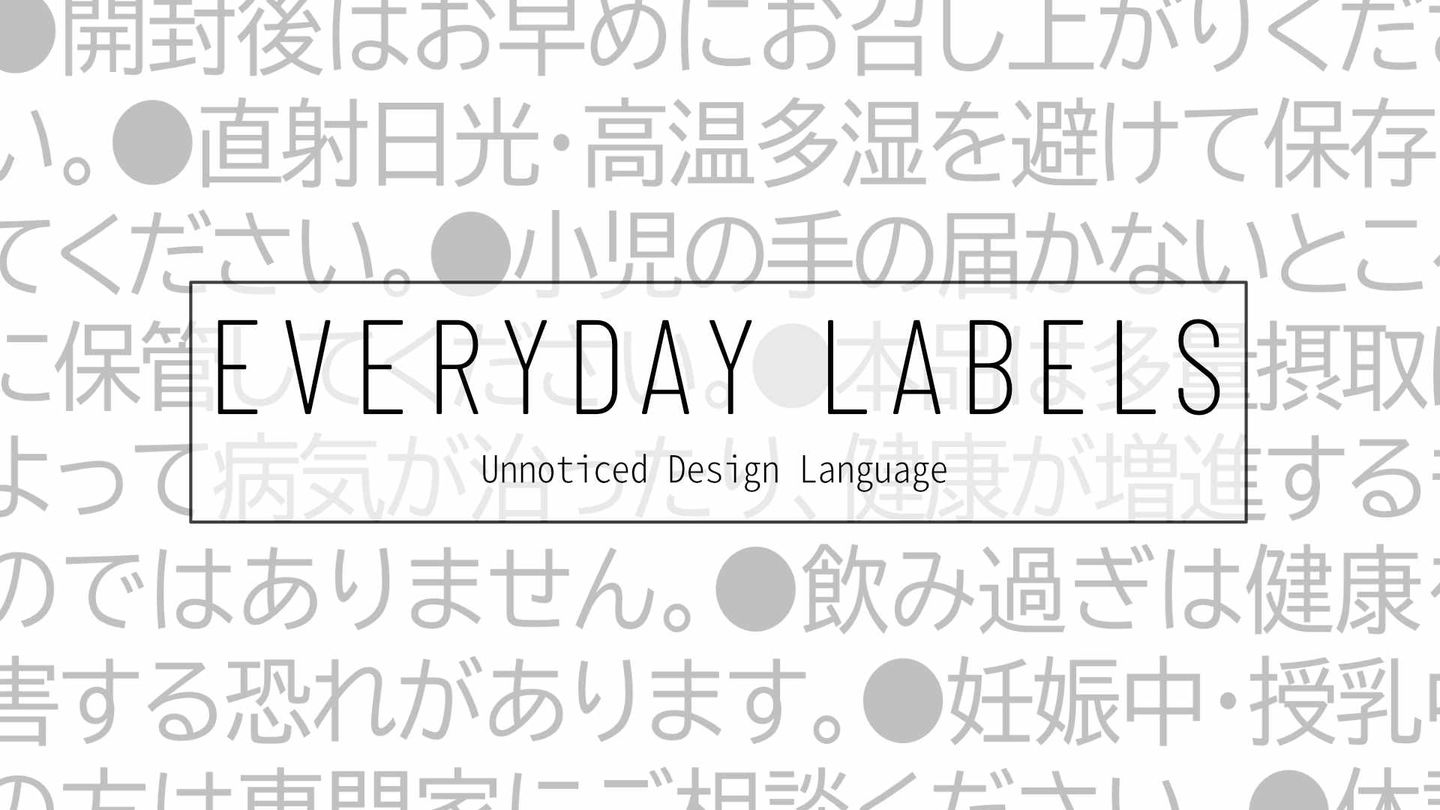
Now that the art and design project EVERYDAY LABELS has taken shape to some extent, I would like to look back on how it got here and gather together some of the things I thought and felt along the way.
EVERYDAY LABELS is an art and design project that puts the labels, warnings, ingredient lists, and other words on everyday products—the words we see but rarely read—at center stage.
…Put that way, it sounds as though everything went according to plan from the beginning. In reality, I was making it up as I went along.
It started with becoming unemployed → wondering if there was some way to avoid getting a regular job → trawling through side-hustle advice → thinking, well, I might as well try something, and impulsively launching a print-on-demand shop for an overseas audience.
Make some designs, put them on products, and list them in a shop. At first, I thought that would be enough to make the whole thing work.
But once the products were lined up, something still felt off.
“You see, the lack of explanation is intentional.”
Only people who already seem important can get away with presenting a work that needs an excuse like that attached to it.
Apparently, the things for sale are not enough
I have never studied design, art, or marketing, nor have I worked in any of those industries. So I do not really know the established techniques or theories of making and selling things.
Still, as I tried to think it through and looked at the things being sold in the world, it seemed that creating how “the thing” is presented is just as important as creating the thing itself.
When I am developing an idea, something like a setting tends to form around the design. Where might this exist? Who might use it? What sort of place might it have come from? I began to wonder whether placing these “things generated in the process” near the object for sale might change the way it was seen.
At first, I intended to add something like a short piece of flavor text. But when I actually started writing, shortening it made it feel strange; leaving things in made it grow longer; cutting it down again made it incomprehensible.
In the end, instead of brief descriptions, I began writing somewhat longer pieces.
(I have written about this part of the process in earlier articles.)[1][, 2]
Even with text added, a product is still a product
I was working on OPERATION LEFT[3] while exploring how to present the products. For that project, I built a structure in which episodes based on a fictional world accompanied the merchandise.
Rather than explaining the product itself, I created a world in which that product seemed likely to exist. I placed the real merchandise inside the episodes and connected the two.
I enjoyed this approach. Finding the act of making something interesting in itself struck me as an important part of being able to continue—especially for someone as easily distracted as I am.
It was fun, and things were getting made, but a slight discomfort remained. No matter how much setting or text I added, as long as the place was a shop, the assumptions of “buying” and “selling” were still there. Which is only natural for a shop.
Being overtly commercial did not feel right.
If I was going to worry so much about how to sell things, perhaps it would be easier to approach it as though I were giving up on “trying to sell” altogether.
If so, displaying them as “exhibits” rather than lining them up as “products” might feel more natural.
—Following that discomfort led me to this idea.
Making the supporting role the star
In EVERYDAY LABELS, the everyday “label” takes the starring role. Labels were a motif I chose more or less on a whim when I first launched the POD shop.
According to some dubious side-hustle advice claiming that “there is money to be made in overseas POD,” designs incorporating Japanese culture would sell like crazy to international customers. But overtly “Japanese-looking” designs did not appeal to me, and the market was already so crowded with them that they offered no particular advantage. While researching, I came across a claim that overseas designers admired the intricate design of Japanese labels. I casually settled on labels, thinking they would be less likely to overlap with what everyone else was doing.
So I made the designs, put them on merchandise, and opened the shop.
This is where it connects to the story above—thinking about presentation and creating another project along the way.
How could I present this handful of merchandise sitting there on its own?
I considered attaching formal, academic-sounding texts that explained and introduced Japanese label culture. But that alone would not be very interesting. Besides, research into label culture is completely outside my area of expertise, so anything I wrote in that style would lack credibility. I was wondering what to do when an idea came to me while I was creating episodes for the other project, OPERATION LEFT.
Why not make this “fictional” too?
Creating a fictional person
That was when I created a fictional author named Julian Fenwick.
A British translator who has lived in Japan for many years.
A slightly unusual person who cannot help noticing the labels and warnings on everyday products.
In his mid-forties, slim, wearing glasses and a white Oxford shirt, living in a place like this, with hobbies like these….
I decided what he was like entirely by feel, without any real basis for the details. I simply imagined that someone who wrote this sort of text would probably be something like this.
When “I” am the one writing, I unconsciously worry about consistency with my own identity. Is this really what I think? Am I overexplaining if I put it this way? But once the writing belongs to “someone else,” I can write without overthinking in a good way. I can use turns of phrase I would not normally use. I can notice things I myself would pass by. I can accept a way of thinking different from my own.
Even though I am the one who wrote it, I can also feel more forgiving about typos or mistakes: “Well, he is only human. It happens.”
Fictionalizing the place while I am at it
Once Julian existed as a fictional person, it seemed that the place where his writing appeared—the shop—might as well be fictionalized too. So, once again acting on impulse, I gave the shop itself a fictional premise.
Originally, it was simply an online shop with a name I had chosen more or less at random as a place to put POD merchandise. I decided instead to treat it like an exhibition site run by a fictional studio.
The products are both goods for sale and exhibits.
The texts are both descriptions and parts of an archive.
Julian is both an author and a character within the work.
None of this was planned, but I feel it came together reasonably well.
I created Julian because the idea sounded interesting; then, because Julian existed, I made Studio Asahi slightly fictional too. Little by little, the structure became nested inside itself.
Between merchandise and exhibits
If I think of it strictly as a POD shop, I should probably sell the products more clearly. Communicate what is good about them, how to use them, the price, and why someone should buy them—all in a catchy way. Cover the fundamentals of making sales. Follow the established theory without adding unnecessary twists before mastering the basics. Something like shuhari—first follow the rules, then break from them, then transcend them—perhaps?
But I cannot quite bring myself to do the work of “selling”: using social media for that purpose, running ads, and so on.
For now, I want people to look.
If possible, I want them to read.
At the very least, even if they do not read, I want them to notice that something is there.
Thinking this way, presenting the site as an exhibition felt more natural than presenting it as a shop. Of course, all I have changed is the presentation; the things on display are still for sale.
It is a place for selling, but selling is not its only purpose. The objects look like exhibits, but they can actually be purchased. Part of me thinks I should define it more clearly, but for now I have decided that this in-between quality suits me just fine.
What is commerce, anyway?
Rather late in the process, I have begun to wonder whether I might not be cut out for commerce. I feel a little like the middle-aged owner of a ramen shop declaring in an interview, “I am no businessman.”
My image of commerce is that you conduct careful research, make and execute a plan, and then close the gap between the plan and the results. Compared with that sort of proper, businesslike operation, what I am doing feels rather vague and ungrounded.
Choosing labels as a motif.
Making unread words the main attraction.
Having a fictional author observe them.
Using a shop as a gallery.
None of these things were planned from the beginning. …Come to think of it, there was no “business plan” before any of them, either.
If you look up the essence of commerce, you find answers like the following. But these explain commerce from the perspective of the person conducting it; they do not describe commerce itself.
Business models such as subscriptions, freemium services, and consumable products are “blueprints for keeping commerce going efficiently.”
Principles such as benefiting all three parties or putting the customer first are “manners that keep the other party from rejecting the exchange.”
Then what is commerce itself?
“Taking on what someone else cannot or will not do, and receiving trust or money in return.”
This wording makes practical services and work performed on someone else's behalf easy to picture, but it does not explain everything else quite as clearly. Manga artists are not drawing pictures in place of their readers. Film directors, idols, game developers, and athletes are not taking over someone else's task. (Or perhaps they are taking on the work of giving form to an imagined possibility….)
For entertainment, something closer might be: “creating worlds and emotions that cannot be fully experienced in ordinary life, and moving the hearts of those who receive them.”
Taking all of that into account, perhaps commerce could also be described as the act of moving the total sum of people's emotions, and being compensated for the distance they travel.
A business that helps someone in difficulty removes inconvenience, trouble, pain, or anxiety, moving that person's emotions toward a place where they feel “That helped” or “Things are easier now.”
Entertainment introduces excitement, wonder, thrills, or comfort into ordinary days, uneventful stretches of time, and weekends when nothing happens.
A bottle of water when you are thirsty and a manga series you read all at once on a day off move a person's state in different directions, but both move it “somewhere other than here.” Commerce is an exchange of value, a circulation of trust, and also a movement of emotion.
Now that I have written it out, commerce does not seem simple enough to capture so easily in words. The idea appears to contain a great deal that cannot be resolved through logic alone: intuition and negotiation, desire and restraint, expectation and disappointment, timing and luck.
Business models and principles can be learned. But perhaps the answer to the question “What is commerce?” only begins to take shape little by little, each time I make something, offer it to someone, and receive their response.
In the end, as a complete beginner who has only just started, I do not really know what commerce is. But making things up as I go seems to suit me, so I will try not to worry about it too much.
For a while yet, I expect I will keep wandering between merchandise and exhibits, looking for ways to present what I make.
Links
Footnotes
- Back to text
How I came up with the idea of adding text: Design Alone Wasn’t Enough
- Back to text
How I came to place texts from another project in TALES: When Design Alone Wasn't Enough: Stories for a POD Shop
- Back to text
OPERATION LEFT → A separate project centered on worldbuilding and a collection of short episodes.
DID YOU ENJOY THIS ARTICLE?
制作活動を支援する / Support my work
文章、アート、デザイン、個人開発を続けるための支援を、コーヒー一杯分から受け付けています。 / Help me keep making essays, art, design, and independent software.

Information