This article serves as background material for the following article on note:
Algorithm Fantasia — What Do Platforms Dream Of? | OneOffObject
1. Introduction: Platforms as Environments, Creators as Organisms
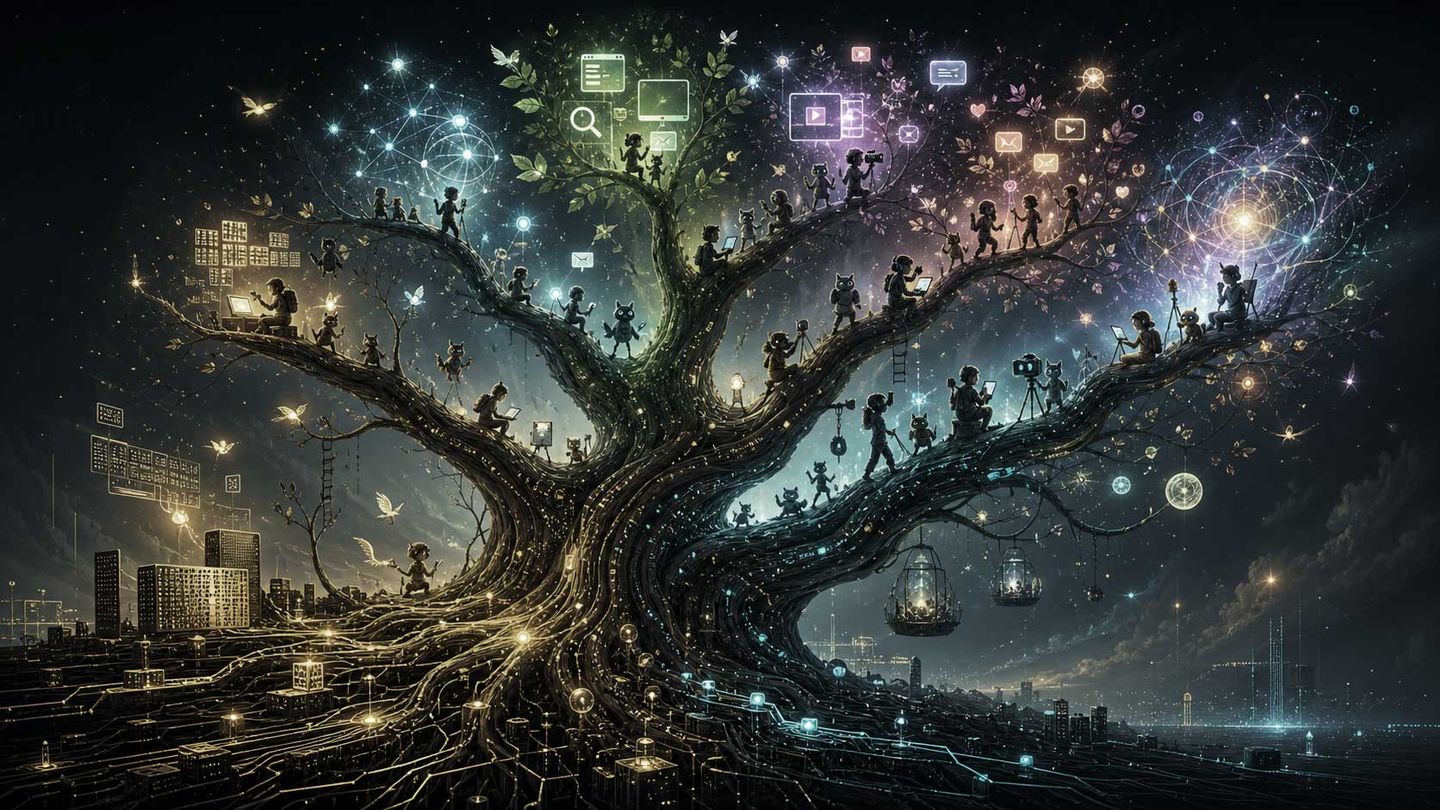
The history of information technology is more than a record of advances in hardware and software. It is also a sweeping history of adaptation, evolution, and symbiosis between the organisms we call “creators,” who put information into the world, and the environments they inhabit: “platforms.”
Platforms provide creators with infrastructure, but they also exert constant “environmental pressure” through proprietary algorithms, monetization requirements, and community guidelines. Just as climate change and continental drift have dramatically reshaped organisms in the natural world, search-engine updates and changes to social-media features have produced irreversible mutations in creators’ modes of expression, content formats, and ethical outlooks.
This article reframes the changing information environment—from the conceptual birth of computing in the 1930s to the age of generative artificial intelligence in 2026—as a single “ecosystem.” It distinguishes factual technological and institutional changes from creators’ interpretations of and adaptive responses to them, including SEO tactics, algorithm hacking, and decentralization away from individual platforms, then analyzes both chronologically. In doing so, it asks what kind of order—or dream—platforms imagine as they reshape their environments, and how creators have sought new forms of expression and new business models by resisting, exploiting, or even living parasitically within those systems.
2. A Timeline of Platform History (1936–2026)
The timeline below summarizes the major environmental shifts from the beginnings of information technology to 2026, together with the ways creators—and users—adapted in response.
Proposal of Turing machine
Computing HistoryChanges on the Platform Side
The concept of an abstract machine capable of executing any computable algorithm is proposed.
Creator Response and Adaptation
(Acceptance of the concept) Mathematicians and engineers began exploring the possibilities of logical calculations.
Impact and Outcome
The theoretical foundations of all modern computer architectures were established.
Publication of ENIAC
Computing HistoryChanges on the Platform Side
Practical use of electronic computers. It used a huge vacuum tube and was intended for things such as trajectory calculations.
Creator Response and Adaptation
Direct programming (adaptation) by physically changing punch cards and cables.
Impact and Outcome
This marked the beginning of automation and speeding up of information processing, and a new academic field called computer science was born.
Birth of ARPANET
Network HistoryChanges on the Platform Side
A packet communication experiment between multiple locations is successful, and a distributed computer network is constructed.
Creator Response and Adaptation
Researchers begin sharing resources and exchanging academic data from remote locations.
Impact and Outcome
A decentralized network philosophy was formed in which communications could be maintained even if the central node was destroyed.
The advent of email
Network HistoryChanges on the Platform Side
A protocol is invented to send text messages to individuals over a network.
Creator Response and Adaptation
It quickly adapted to asynchronous communication and dramatically improved the speed of information sharing.
Impact and Outcome
It became the origin of a culture of personal digital communication that replaced letters and telephone calls.
Founding of Usenet
Early Online CommunitiesChanges on the Platform Side
Tom Truscott and others build a bulletin-board system using hierarchical newsgroups [1].
Creator Response and Adaptation
Form communities for each area of interest and engage in decentralized discussions.
Impact and Outcome
It became the template for later BBS and anonymous bulletin boards, and the early “Flame” phenomenon also occurred during this period.[1]
Popularization of personal computers
Computing HistoryChanges on the Platform Side
Inexpensive computers that can be owned and operated by individuals, such as the Apple II and IBM PC, are available on the general market.
Creator Response and Adaptation
Independent from the mainframe administrator, individuals begin programming and digital creation in their own rooms.
Impact and Outcome
Digital technology has been liberated from a few experts, setting the stage for content production by the general public.
Establishment of The WELL
Early Online CommunitiesChanges on the Platform Side
An early online community is established by Stuart Brand and others [1].
Creator Response and Adaptation
Hackers, hippies, journalists, and others gather to experiment with social construction and dialogue in virtual space.
Impact and Outcome
It proved that online communities can become “society that is an extension of reality,” and gave rise to a unique culture of cyberspace.[1]
World Wide Web Publishing
Internet HistoryChanges on the Platform Side
Tim Berners-Lee launches the first website and server at CERN [2].
Creator Response and Adaptation
Learned HTML and manually built an initial personal site consisting only of text and hyperlinks.
Impact and Outcome
An open environment has been created in which anyone can link information to each other and publish it free of charge to the world [2].
Web browser development
Internet HistoryChanges on the Platform Side
Browsers with GUIs such as Mosaic have appeared, making it possible to display a mixture of images and text [2].
Creator Response and Adaptation
Expressions evolved to include not only text but also images, and a new field of expression called "web design" was opened up.
Impact and Outcome
The Web became the biggest trigger for its spread from academic use to the general public, and the possibilities for commercial use expanded explosively [2].
Launch of SixDegrees.com
SNSChanges on the Platform Side
The emergence of early SNS that allows users to create profiles and visualize and expand their friendship relationships [1].
Creator Response and Adaptation
An attempt to visualize the breadth of one's network by bringing real-life acquaintances into the digital space.
Impact and Outcome
It established the concept of today's "social graph", but it declined early due to the lack of communication infrastructure at the time [1].
Birth of Google
searchChanges on the Platform Side
The emergence of a search engine that uses the “PageRank” algorithm, which uses the citation index of papers and uses the number of backlinks as an evaluation criterion [2].
Creator Response and Adaptation
Adaptation to the rule that "more backlinks = more value". Creating mutual link collections and forming web rings is becoming popular.
Impact and Outcome
Search accuracy has improved dramatically. At the same time, the concept of “SEO (search engine optimization)” was born, and competition for traffic began [2].
Establishment of 2channel
Bulletin BoardsChanges on the Platform Side
A completely anonymous, thread-floating, huge bulletin board has been created in Japan.
Creator Response and Adaptation
Gaining the right to speak without an avatar, giving up your real name. Invented ASCII art (AA) and original internet slang.
Impact and Outcome
A culture of anonymity unique to Japan and a participatory/commentary speech space were formed, which became an axis of opposition to the mass media.
Birth of Blogger/LiveJournal
blogChanges on the Platform Side
Introducing a CMS/hosting service that allows you to post diaries on the web without any knowledge of HTML [4].
Creator Response and Adaptation
From "We blog" to "Blog". Technological hurdles have been lowered, and text-based personal communications have proliferated [5].
Impact and Outcome
The main focus of web content has shifted from static pages to chronological dynamic updates (feeds), and the voices of individuals have become visible [4].
Popularization of RSS
Distribution TechnologyChanges on the Platform Side
The emergence of a format for structuring and distributing website update information [5].
Creator Response and Adaptation
By utilizing RSS readers, creators have acquired a "Subscribe" model that eliminates the hassle of visiting and retains readers [5].
Impact and Outcome
It was a period of transition from a “pull type” (search and find) content to a “push type” (updates delivered), and the personalization of media progressed.[5]
The advent of Wikipedia
Web 2.0Changes on the Platform Side
Launch of an open source online encyclopedia that anyone can edit [2].
Creator Response and Adaptation
Formation of a self-purifying culture in which anonymous crowds collaborate (crowdsourcing) to compile and modify knowledge as collective knowledge.
Impact and Outcome
It became an iconic success story of Web 2.0, shifting the ownership of knowledge from authoritative experts to a participatory public [2].
Introducing Friendster/MySpace
SNSChanges on the Platform Side
The rise of highly customizable SNS that connects people through music and hobbies [1].
Creator Response and Adaptation
Decorate your profile page with HTML/CSS and use it as a place for self-expression. A place to promote indie bands.
Impact and Outcome
The Internet has transformed from a pure textual exchange of information to a place of identity and entertainment [1].
Birth of Facebook
SNSChanges on the Platform Side
It originally started as a real-name profile network for Harvard University students [2].
Creator Response and Adaptation
The formation of a culture of displaying an active, socially fulfilled offline life through education and relationships (educational background, relationships) online and use it as social proof.
Impact and Outcome
The “real-name social graph” has grown into the most powerful infrastructure on the Internet, and the integration of the anonymous Internet with reality has progressed [2].
YouTube launch
VideoChanges on the Platform Side
The birth of a Flash-based video sharing platform with the slogan "Broadcast Yourself" [7].
Creator Response and Adaptation
Individuals began to freely upload home videos, game commentary, song covers, etc., without relying on broadcast stations.[7]
Impact and Outcome
The democratization of visual media was achieved, and the foundation was laid for what would later become the world's largest entertainment economy.[7]
Start of Niconico Douga
VideoChanges on the Platform Side
Implemented a unique Japanese UI where viewer comments flow synchronously over the video like a barrage [8].
Creator Response and Adaptation
The appearance of a craftsman (comment art, MAD video creator). Grassroots culture and derivative works such as “I tried singing” and “game commentary” have developed [8].
Impact and Outcome
The complicit relationship between creators and viewers has become stronger, and Japan's unique UGC (user-generated content) culture has expanded explosively.[8]
Twitter launch
SNSChanges on the Platform Side
"Microblog" with a 140 character limit. The main focus is real-time situation sharing (What are you doing?) [9].
Creator Response and Adaptation
It utilizes the immediacy of short sentences and hashtags (introduced in 2007) that are spontaneously generated by users to create live commentary and buzz [9].
Impact and Outcome
The speed and dissemination of information has reached its maximum, and the flow of information has completely shifted from a stock type to a flow type.[9]
YouTube Partner Program (YPP) started
MonetizationChanges on the Platform Side
Started distributing advertising revenue to outstanding content creators based on the number of views, etc. (initially based on a screening system) [7].
Creator Response and Adaptation
The birth of a new profession called "YouTuber". In order to increase the number of views, people are posting more every day and taking on more extreme projects [10].
Impact and Outcome
There has been a polarization from amateurs who “speak out because they like it” to professionals who “make a living by earning views.”[11]
Launch of App Store and popularization of smartphones
platformChanges on the Platform Side
Apple opens a sales platform for third-party apps for iPhone.
Creator Response and Adaptation
Responding to mobile-first trends. Shifting from a design for PC to a UI/UX that assumes touch operation on a vertical screen.
Impact and Outcome
The place for consuming information has shifted from "on your desk" to "in your pocket," and the age of 24-hour connectivity has arrived.
Introduction of Facebook algorithm feed
algorithmChanges on the Platform Side
A shift from chronological display (Recency) to relevance-ordered display (Relevance) based on user engagement [12].
Creator Response and Adaptation
Become strategically aware of posts that elicit user responses (clicks, likes, comments) (engagement bait).
Impact and Outcome
We have entered an era where users are not looking at the latest information, but instead looking at information that the platform has determined will make users stay for a long time.[12]
Google Panda update
search engineChanges on the Platform Side
Copy content, thin content pages, and quality ratings that significantly lower search rankings for content farms [13].
Creator Response and Adaptation
Changed policy from mass production of articles to creating “original, high-quality content.” Deleting and rewriting (auditing) past low-quality articles has become the norm [13].
Impact and Outcome
Poor affiliate sites and automatically generated blogs have been destroyed, and the importance of content SEO that emphasizes user experience has been recognized [13].
Google Penguin update
search engineChanges on the Platform Side
Severe penalties for spammy backlinks (self-created, purchased links, excessive keyword stuffing) [14].
Creator Response and Adaptation
Abandon black hat SEO (link purchasing) and return to writing high-quality articles (white hat) to acquire natural backlinks [14].
Impact and Outcome
The era of "SEO measures = system hacks" is over. The reliability and authority of information has become more important [14].
Launch of Vine
VideoChanges on the Platform Side
Introducing a short video sharing app that loops for 6 seconds (under Twitter) [16].
Creator Response and Adaptation
Comedies that hit the punchline under extreme time constraints and jump-cut techniques that ignore the laws of physics were refined.[18]
Impact and Outcome
The unique grammar of short videos and influencers (viners) have been established. It formed the foundation for the later TikTok boom, but it declined due to the inability to monetize it.[18]
Canva launch
Creator ToolsChanges on the Platform Side
Release of a tool that allows anyone to perform advanced graphic design on a browser [21].
Creator Response and Adaptation
People who don't have expensive specialized software (such as Adobe) are getting into thumbnail creation and SNS image creation.
Impact and Outcome
With the democratization of design, competition in visual expression (thumbnail and title optimization) on SNS and blogs has intensified [21].
launch of note
Blogs / MonetizationChanges on the Platform Side
Aiming to break away from advertising dependence, a platform has been created in Japan that allows users to directly sell (charge) content such as text and images.[23]
Creator Response and Adaptation
Creators moved away from page-view absolutism and outrage tactics, instead writing high-quality work for niches and receiving direct payments from core fans.[23]
Impact and Outcome
This was a decisive opportunity for the "creator economy (direct billing/fan community)" to take root in Japan.[23]
Facebook's "Pivot to Video"
Video / Corporate StrategyChanges on the Platform Side
Facebook has changed its algorithm to give extreme preferential treatment to video content. Strongly urge media to shift to video [12].
Creator Response and Adaptation
Many publishers are laying off text article editors and shifting budget to short-form video teams (Pivot to Video) [26].
Impact and Outcome
It was later discovered that Facebook's video viewing time data was inaccurate (inflated), leading to mass job losses and severe distrust in the media industry.[26]
The rise and decline of curation media
Blog / SEOChanges on the Platform Side
“Summary sites” that use crowdsourcing to aggregate information from other sites dominate the top search results.
Creator Response and Adaptation
Low-cost writers mass-produce long SEO articles that match the search intent (keyword) and end with "How was it?".
Impact and Outcome
Serious inaccuracies in medical information, etc. (WELQ issues, etc.) were exposed, leading Google to issue a quality update unique to Japan.
Start Instagram Stories
SNSChanges on the Platform Side
Ephemeral posting function that disappears in 24 hours. Blatantly imitated Snapchat's features and integrated them into their own company [29].
Creator Response and Adaptation
The use of feeds (permanent photos that look good) and stories (real, unedited images of everyday life) have become established [30].
Impact and Outcome
Creators are freed from the shackles of “looking good” and are now able to contact fans more frequently and build intimate relationships.[29]
Birth of VTuber (Kizuna AI)
Video/StreamingChanges on the Platform Side
The emergence of "virtual YouTubers" using 3D avatars and motion capture technology [31].
Creator Response and Adaptation
Creators moved beyond the constraints of physical bodies and appearances, combining a character persona with the conversational skill of the performer behind the avatar [31].
Impact and Outcome
A huge VTuber industry (Super Chat/live economic zone) was formed, led by offices such as Nijisanji and Hololive.[32]
1st Adpocalypse (ad removal)
Monetization / RegulationChanges on the Platform Side
Major advertisers have withdrawn all at once after their ads were displayed on extreme/hate videos on YouTube. Introduction of “yellow dollars (monetization restrictions)” [35].
Creator Response and Adaptation
Refrain from radicalizing thumbnails and titles. “Self-censorship,” which hides inappropriate words, is widespread. We have also started direct support from external sources such as Patreon [35].
Impact and Outcome
The platform's complete dependence on advertising revenue was recognized as dangerous, and creators' revenue diversification (direct billing, merchandise sales) accelerated.[35]
Launch of Substack
MonetizationChanges on the Platform Side
Birth of a mail magazine-style newsletter distribution/paid subscription platform [37].
Creator Response and Adaptation
Journalists and experts move to media that doesn't rely on algorithms and delivers "directly to readers' inboxes." They make a living from the subscription fees of a small number of enthusiastic readers.[37]
Impact and Outcome
The rise of the subscription-based creator economy (third generation platforms) has become a haven for quality journalism.[38]
Introducing YouTube Super Chat
MonetizationChanges on the Platform Side
Addition of a tipping feature that lets viewers pay to highlight their comments during live streams [40].
Creator Response and Adaptation
Emphasis on interaction during live broadcasts. Enhance real-time engagement that satisfies the viewer's desire for recognition, such as by calling out their name [42].
Impact and Outcome
In particular, it became an explosive source of income for VTubers and gameplay streamers, resulting in a major shift from posting recorded videos to live streaming.[42]
COPPA compliance and 2nd Adpocalypse
Monetization / RegulationChanges on the Platform Side
In response to the FTC's huge fine, YouTube disabled targeted advertising for "Made for Kids" content and restricted comments, etc.[35]
Creator Response and Adaptation
Advertising revenue for kids/family YouTubers has plummeted by 60-80%. There has been a series of withdrawals from children's content and changes to productions that raise the target age group.[35]
Impact and Outcome
This highlighted the risk that changes to platform rules (particularly legal pressure from outside) could wipe out a particular group of creators overnight [35].
Complete domination of TikTok and Interest Graph
algorithmChanges on the Platform Side
“For You” feeds are emerging, which do not rely on follower relationships (Social Graph) and use machine learning to endlessly provide the most suitable videos based on the user's behavior history [12].
Creator Response and Adaptation
Developing a "hook" that strongly attracts the viewer in the first few seconds. Thorough use of songs and piggybacking on popular dances (meme-ization) in order to be selected by algorithms [43].
Impact and Outcome
We are living in an era when “the excitement and context of the content itself” is valued more than “who posted it”. It gave rise to copycat features such as YouTube Shorts and IG Reels.[29]
Google Helpful Content Update
search engineChanges on the Platform Side
A core update written solely for SEO purposes that lowers content that is "useless" to humans [44].
Creator Response and Adaptation
Emphasis on "primary information" and "unique experiences" that satisfy the reader's intentions. The conventional method of “How was it?” type summary sites will no longer be effective [44].
Impact and Outcome
The decline of superficial keyword-exhaustive articles and the importance of authors (E-E-A-T: experience, expertise, authority, trustworthiness) have become more important than ever [44].
Acquisition and rebranding from Twitter to X
platformChanges on the Platform Side
Acquisition by Elon Musk, open algorithm, and start of paid verification (X Premium) and creator ad revenue sharing [9].
Creator Response and Adaptation
Engagement baiting (impression zombies) is becoming more prevalent, obtaining blue badges (Premium) and gaining impressions by “piggybacking on the reply column” or “inciting conflict.”[46]
Impact and Outcome
The borders of speech space are collapsing. On the other hand, although the return rate for some creators has increased through revenue sharing, the battle against spam has intensified.[46]
X creator optimization and revenue structure changes
MonetizationChanges on the Platform Side
Declared 2026 the “Year of the Creator.” Stricter rules such as only “verified impressions” by Premium subscribers being monetized [48].
Creator Response and Adaptation
Adaptation to eliminate mutual engagement (spam) with automated tools (InfoFi). Exploration of essential dialogue using long posts (Articles) etc.[47]
Impact and Outcome
There has been a shift towards an ecosystem where "high-quality engagement from valuable users" rather than the number of followers is directly linked to revenue [49].
Spread of generative AI tools (LLM, CapCut, etc.)
Creator ToolsChanges on the Platform Side
The explosive spread of LLM (ChatGPT, etc.) and AI video editing (CapCut, Opus Clip, etc.). Anyone can create like a professional [22].
Creator Response and Adaptation
Script creation, audio generation, and cutout video generation are replaced by AI, and the mass production and efficiency of “Faceless channels” is progressing to the utmost [52].
Impact and Outcome
At the same time as the democratization of content creation, the market became saturated and homogenized due to a large amount of AI content (Slop), resulting in information deflation [52].
Generative AI copyright controversy and AI Adpocalypse
Regulation/AlgorithmChanges on the Platform Side
YouTube introduces “Inauthentic Content” policy (July 2025). De-monetization of AI-generated videos without human editing intervention [35].
Creator Response and Adaptation
Returning to the “Human Angle,” which uses AI tools as “assistance” rather than “substitutes,” and intentionally retains unique points of view (POV) and human errors and charms [35].
Impact and Outcome
The collapse of the passive income model due to complete automation. A paradigm shift has occurred where “individuality and context that only humans can provide” once again becomes the highest premium value [35].
3. The Evolution of Platform Ecosystems: Eras and Paths of Adaptation
As information technology and business models changed, the relationship between platforms and creators passed through dramatic phases comparable to those in biological evolution. The eras below show how each period’s environmental pressures selected against certain forms of expression while producing new kinds of adapters.
Era One: The Primordial Network Ocean and the Cambrian Explosion (1936–1997)
Before today’s polished interfaces and algorithms, networked space resembled a “primordial ocean,” the source from which life would emerge. After Alan Turing proposed the conceptual model of a computing machine in 1936 and ENIAC put electronic computing into practice in 1946, computers emerged as massive infrastructure accessible only to a privileged few researchers and military engineers. The “creators,” or adapters, of this age were a small elite who communicated directly with machines by physically rewiring cables and using punch cards.
Beginning with ARPANET in 1969, isolated points became connected and the idea of a network took shape. With email in 1971 and Usenet in 1979, people acquired a new form of asynchronous digital dialogue.[1] The spread of personal computers in the 1980s then liberated computing from giant research facilities and brought it into private rooms. Early bulletin-board systems such as The WELL, founded in 1985, formed virtual tribes of hackers and hippies, demonstrating that online communities could function as societies extending from the physical world.[1]
When Tim Berners-Lee made the World Wide Web public in 1990, static text acquired the connective tissue of hyperlinks, and information around the world began to interlink like a web.[2] Browsers such as Mosaic, appearing from 1993 onward, gave this world a visual dimension.[2] Creators at the time were those who could overcome the high technical barrier—the environmental pressure—of writing HTML tags by hand. Without worrying about what search engines wanted, they built homepages out of a pure desire to publish and share information. With no commercial rules yet in place, it was a Cambrian-like age in which a remarkably pure and unruly diversity exploded into being.
Era Two: Search-Engine Adaptive Radiation and Blogs Move Ashore (1998–2005)
The rise of search engines brought the absolute order of “evaluation” to a chaotic network ocean. Founded in 1998, Google used PageRank—an algorithm based on the number of inbound links—to create a clear hierarchy across the Web.[2] To adapt, publishers formed reciprocal-link directories and webrings, mutually conferring value in the struggle to rank higher in search results. This established search engine optimization, or SEO, as a deliberate direction of evolution.[2]
At the same time, expression made a mass migration from the “sea” of static homepages onto the “land” of blogs built for continual updates. Content management systems such as Blogger and LiveJournal, both launched in 1999, removed the technical barrier of knowing HTML and made it possible for anyone to document and publish everyday life.[3] With the birth of the “weblog,” text content entered a period of mass proliferation.[4] RSS turned readers from active explorers into “subscribers,” while trackbacks created networks of asynchronous communication between blogs.[4]
In Japan, 2channel launched in 1999, giving rise to a distinctive culture of fully anonymous collective intelligence and ASCII art. Wikipedia’s arrival in 2001 symbolized the transfer of ownership over knowledge from experts to a “participatory public,”[2] while the rise of Friendster and MySpace from 2002 onward began to form an early “social graph” around music, hobbies, and self-expression.[1]
Era Three: The Formation of Social Pangaea and the Mobile Shift (2006–2010)
Scattered personal blogs and websites were rapidly absorbed into the social-media “supercontinent”—a Pangaea—provided by giant platform companies. Facebook, founded in 2004, used real-name identities to map offline relationships into digital form,[2] while Twitter, launched in 2006, pushed immediacy and the flow of information to an extreme through its 140-character limit.[7]
The main arena of entertainment also shifted from text to video. YouTube, launched in 2005, allowed individuals to distribute video without relying on broadcasters.[5] Especially significant was the 2007 launch of the YouTube Partner Program (YPP).[5] By turning views directly into money, it introduced a potent new nutrient into the ecosystem and produced a professional predator class: the YouTuber.[8] In Japan, Niconico introduced its distinctive interface of synchronized comments streaming across the video in 2006, creating a “paradise of derivative works and user-generated content” in which creators and viewers completed the work together.[6]
The launch of the App Store in 2008 and the rapid spread of smartphones then moved information consumption decisively from “the computer on the desk” to “the device in the pocket.” As screens became vertical and touch became the dominant mode of interaction, platforms evolved toward mobile-first interfaces and experiences, exposing users to environmental pressure around the clock. In 2009, Facebook’s shift from a chronological feed based on recency to an algorithmic feed based on relevance marked a historic transfer of control: what people saw was no longer governed by what was newest, but by what the platform judged relevant.[10]
Era Four: The Algorithmic Ice Age and the SEO Mass Extinction (2011–2016)
Faced with an oversupply of information, platforms unleashed powerful algorithmic purges—an ice age intended to cleanse the ecosystem. Google’s Panda update removed thin content farms from search results in 2011, followed by the Penguin update’s elimination of black-hat SEO sites built on spammy backlinks in 2012.[11] Creators who depended entirely on SEO hacks underwent a mass extinction, and survivors had to shift toward high-quality, user-centered content and white-hat SEO.[11]
Algorithm changes, however, do not always lead to beneficial evolution. In 2015, Facebook abruptly pivoted toward an algorithm that heavily favored video, and many media companies followed its lead by laying off text-focused staff.[19] Facebook’s video-viewing metrics were later found to have been inflated, teaching the media industry a painful lesson about the danger of blindly obeying a platform’s numbers.[19]
Meanwhile, in Japan’s text-based media ecosystem, crowdsourced curation sites flourished by cheaply stitching together information from elsewhere. Low-quality SEO articles ending with the stock phrase “How was it?” polluted the top search results. The problem became serious enough that Google eventually introduced an algorithm adjustment specific to Japan.
On social media, Vine, launched in 2013, refined a distinctive grammar of short-form video—jump cuts and other techniques—within an extreme six-second limit, but declined because it lacked a viable path to monetization.[14] Instagram Stories, introduced in 2016 in imitation of Snapchat, released creators from the pressure to make every post perfectly photogenic. It established ephemeral communication as a way to share the unpolished backstage of daily life.[21]
Era Five: Platform Fragmentation and the Rise of Direct Support—the Creator Economy (2017–2019)
An ecosystem dependent on advertising revenue from a single platform was extremely vulnerable to external change. In 2017, major advertisers withdrew from YouTube after their ads appeared alongside hateful videos, triggering the first Adpocalypse. Many creators were hit with the “yellow dollar” of limited monetization and forced into self-censorship and restraint.[26] In 2019, FTC sanctions over violations of COPPA, the Children’s Online Privacy Protection Act, led YouTube to disable targeted advertising on content for children. Creators in some genres suffered a devastating blow in what became the second Adpocalypse.[26]
That survival instinct—the need to escape dependence on advertising—drove the rise of a third generation of platforms built around direct audience payments and the creator economy. Launched in 2017, Substack established a model in which fans pay creators directly for email newsletters that do not depend on algorithmic distribution.[27] In Japan, note, which had launched in 2014, grew significantly during this period and helped establish a culture of selling high-quality writing directly to readers.[18]
The VTuber, or virtual YouTuber, was another evolutionary mutation of this period. Following Kizuna AI’s debut in late 2016, creators established a streaming style that used motion capture and 3D avatars to create digital personas liberated from the physical body.[23] YouTube’s Super Chat feature, introduced in 2017, paired perfectly with VTuber culture, producing a vast live-streaming economy built on real-time interaction and viewers’ desire for recognition.[25]
Era Six: The Adaptive Radiation of Short Video and the Dominance of the Interest Graph (2020–2023)
In the 2020s, the follower relationships—the Social Graph—that had formed the foundation of social media began to lose their dominance. TikTok was the catalyst. Regardless of whom a user followed, machine learning used behavioral history such as watch time, swipes, and likes to continuously select the most compelling content. TikTok turned this “For You” feed into the industry standard.[10]
Under the rule of the Interest Graph, creators could no longer rely on the accumulated advantage of authority or follower counts. They poured their attention into the first one or two seconds—the “hook” that might stop a swipe—and catered aggressively to trending songs and dances likely to become memes.[31] The wave spread to Instagram Reels and YouTube Shorts, creating the fastest rate of content consumption in history and an era of adaptive radiation as intense as anaerobic exercise.[21]
Text-based spaces also underwent severe environmental change. Google’s 2022 Helpful Content Update targeted “unhelpful” articles written with AI or other means solely for SEO and placed new weight on first-hand information and original experience through E-E-A-T.[32] Meanwhile, after Elon Musk acquired and rebranded Twitter as X in 2023, the introduction of creator ad-revenue sharing encouraged engagement bait. “Impression zombies” fabricated empty conversations in reply threads simply to accumulate views, producing a moral hazard in public discourse.[33]
Era Seven: The Generative-AI Meteor Strike and a Fifth Survival Strategy (2024–2026)
From 2024 onward, the explosive spread of large language models such as ChatGPT and AI-integrated video-editing tools such as CapCut drove the marginal cost of content production toward zero.[37] “Faceless” channels automated scriptwriting, voice generation, and avatar performance at scale, making professional-looking creative production instantly accessible to almost anyone.[38]
Yet the giant meteor of effectively infinite AI-generated content shook the very basis of the ecosystem. Platforms filled with homogenized “AI slop” devoid of human warmth, creating the danger that human audiences would simply leave.[39] In response, YouTube implemented its “Inauthentic Content” policy in July 2025 and launched an “AI Adpocalypse,” removing monetization from fully automated videos that lacked a distinct human point of view, editing, or commentary.[26]
In this final phase, the survival strategy creators need is, ironically, a return to the human. The passive-income model of full automation is collapsing. Creators may push AI to its limits as a supporting workforce, but the greatest premium now lies in deliberately retaining the “human angle” that AI cannot reproduce: embodied mistakes and rough edges, unpredictable emotional context, and strong bonds with a particular niche community.[26]
4. Ten Turning Points That Irreversibly Changed the Ecosystem
The following ten turning points had an especially irreversible impact on today’s information ecosystem. Each is examined in terms of its mechanism and significance.
1. [Independence in Distribution] RSS and the Spread of Blog CMSs (1999)
RSS fundamentally shifted online information consumption from a “pull” model, in which users went out to find websites, toward a “push,” or subscription, model in which updates arrived automatically.[4] CMSs such as Blogger removed the technical barrier of coding HTML and transformed non-engineers into creators.[3] The concept of a chronologically updated feed that users subscribe to became a foundational and nearly inviolable element of the interfaces and experiences of later social networks, including Facebook and Twitter.[3]
2. [The Beginning of Professionalization] The YouTube Partner Program (2007)
This was the historic moment when uploading video online shifted from an unpaid act—an extension of self-expression or a hobby—into a business and profession capable of directly supporting a livelihood through views.[5] This powerful economic nutrient produced a new species: the YouTuber. To maximize the views and total watch time favored by the algorithm, YouTubers rapidly evolved distinctive behaviors: sensational thumbnails and clickbait, longer videos, and daily uploads designed to become part of viewers’ routines. In the process, they wrested dominance in entertainment away from television.[8]
3. [The Ecosystem’s Self-Cleansing Mechanism] Google Panda and Penguin (2011–2012)
Black-hat SEO—buying or generating links at scale, or stuffing pages with keywords hidden in text the same color as the background—ceased to work.[12] For the first time, a platform imposed large-scale sanctions on attempts to exploit loopholes in the system, creating an extinction event that cleansed the ecosystem.[11] Creators could no longer focus on deceiving search algorithms; they had to evolve toward white-hat strategies and produce useful content that performed well on signals such as dwell time and lower bounce rates.[11]
4. [Environmental Betrayal and Distrust of Data] Facebook’s “Pivot to Video” (2015)
The episode impressed on the media industry the mortal danger of depending on a platform’s data and algorithmic direction.[10] Facebook heavily favored video, encouraging publishers to lay off text-focused staff and invest in video teams, only for it to emerge later that Facebook’s video-viewing metrics had been inflated over an extended period.[20] Platforms were not infallible gods of their environments; they could readily steer and destroy a creator ecosystem in pursuit of their own interests, especially greater advertising revenue.[19]
5. [The Separation and Expansion of Identity] The Emergence of VTuber Culture (2016–)
Beginning with Kizuna AI, VTubers succeeded in fully separating a creator’s physical body from their digital persona.[23] Animation culture merged with live-streaming culture, enabling forms of expression that transcended biological constraints such as the performer’s age, appearance, or gender. Systematic production by agencies such as hololive and NIJISANJI, combined with interaction through Super Chat, created a distinctive evolutionary lineage: a vast, globally influential entertainment economy originating in Japan.[24]
6. [Breaking Free of Platform Dependence] The First and Second Adpocalypses (2017 and 2019)
An advertiser boycott in 2017 and major FTC sanctions over violations of children’s privacy law, COPPA, in 2019 led YouTube to abruptly suspend or restrict monetization for tens of thousands of channels.[26] Creators learned that the single feeding ground of platform advertising revenue could close overnight under outside legal or social pressure.[26] The events forced self-censorship while also providing the strongest push yet toward diversification: Patreon, merchandise, and other sources of revenue beyond the platform.[26]
7. [The Dawn of Subscriptions] The Rise of Substack and note (2014 and 2017)
This shift symbolized the creator economy’s maturation into a third generation of direct audience support. Journalists and specialists moved away from the attention economy’s pursuit of indiscriminate clicks and page views and toward newsletters delivered directly to readers’ inboxes, without algorithmic mediation.[27] By owning their customer lists—the email addresses—independently of any platform, creators could make a living from subscriptions paid by a smaller group of devoted fans. The model created a refuge for high-quality work.[18]
8. [The End of the Social Graph] TikTok’s “For You” Algorithm (around 2020)
TikTok effectively displaced “who you follow”—the Social Graph that had underpinned social media for fifteen years—with an Interest Graph in which AI evaluates the appeal of the content itself.[10] Established authority and follower counts lost some of their value, while a completely unknown creator could suddenly reach tens of millions of views overnight.[31] Other platforms followed TikTok’s model through Reels and Shorts, pushing both the speed of consumption and creator exhaustion to their limits.[21]
9. [The Direct Monetization of Engagement] X’s Creator Revenue Sharing (2023–2026)
Under Elon Musk, X’s introduction of creator ad-revenue sharing based on impressions dramatically altered the ecosystem of text-based social media.[7] Posts designed to provoke controversy, and empty attempts to piggyback on viral posts, became directly tied to financial incentives through engagement bait.[33] By 2026, measures such as counting only impressions from Premium users were being used to combat bots, while the evolutionary arms race between the platform and spammers continued to intensify.[34]
10. [Redefining the Human] The AI Adpocalypse and Inauthentic Content Policies (2025–2026)
Platforms finally issued an explicit rejection of “AI slop,” generated in inexhaustible quantities at virtually zero marginal cost.[26] YouTube’s decision to remove monetization from fully automated content without human editing or an original perspective—a human angle—suggested that the endpoint of technical efficiency could be selection against the content itself.[26] Ironically, a new paradigm emerged: human rawness, emotional fluctuation, and inefficient context became creators’ irreplaceable conditions for survival in the AI era.[26]
5. Conclusion: What Platforms Dream Of, and the Future of Creators
The history traced here reveals that platforms and creators remain locked in an endless tension between symbiosis and conflict.
The “environment” of the platform is always dreaming one enormous dream: to enclose every user’s time within its own ecosystem and fulfill the supreme mandate of maximizing time on platform and optimizing advertising revenue through data and algorithms. To realize that dream, platforms repeatedly rewrite the rules—overhauling search algorithms, replacing chronological timelines, changing monetization standards—and attempt to control the ecosystem at will.[10]
Creators, the “organisms” in this environment, have desperately adapted in pursuit of both self-expression and economic survival. From SEO hacks and the invention of clickbait to algorithmic optimization that exploits platform rules and the extensive use of automated tools, the history of creator behavior is itself an evolutionary optimization process: how efficiently can one harvest the fruits of attention and revenue along the unforgiving tracks laid down by the environment?[13]
In 2026, however, this ecosystem faces an unprecedented singularity. Generative AI has driven the cost of producing content itself toward zero.[38] Platforms instinctively recognize that human audiences will eventually leave an ecosystem overrun by sterile, homogenized AI content—slop—and have begun using the drastic medicine of an AI Adpocalypse to defend human authenticity against the inauthentic.[26]
The next survival strategy for creators no longer lies in mechanically hacking algorithms or merely increasing productivity. The next evolutionary step is to escape dependence on any single platform through Substack, note, or self-run communities, and to own a list that environmental shifts cannot take away.[27] Above all, creators must use AI as a supporting workforce while keeping at the center of their work a personal presence, a story that is uniquely their own, and the imperfections and emotional fluctuations that AI can never reproduce.[26]
Creators must secure their own ecological niches without being swallowed whole by the platform’s cold dream of data supremacy, and continue to communicate an intensity that only a human being can generate. In the world after the AI meteor strike, that is the one survival strategy by which the organism called the creator can pass its DNA to the next generation.
Footnotes
- Back to text
Timeline of social media - Wikipedia, https://en.wikipedia.org/wiki/Timeline_of_social_media
- Back to text
The History and Development of New Media — Timeline | by Megan Randalls | Medium, https://medium.com/@560949/the-history-and-development-of-new-media-4c0e4d90dcbb
- Back to text
History of blogging - Wikipedia, https://en.wikipedia.org/wiki/History_of_blogging
- Back to text
A History of Blogging (1993 - Present Day Timeline) - WPBeginner, https://www.wpbeginner.com/research/history-of-blogging/
- Back to text
History of YouTube - Wikipedia, https://en.wikipedia.org/wiki/History_of_YouTube
- Back to text
Niconico - Wikipedia, https://ja.wikipedia.org/wiki/ニコニコ動画
- Back to text
Timeline of X (social network) - Wikipedia, https://en.wikipedia.org/wiki/Timeline_of_X_(social_network))
- Back to text
Partner Program Expands - YouTube Official Blog, https://blog.youtube/news-and-events/partner-program-expands/
- Back to text
Introducing Expanded YouTube Partner Program Safeguards to Protect Creators, https://blog.youtube/news-and-events/introducing-expanded-youtube-partner/
- Back to text
Evolution of Social Media Algorithms: The Invisible Hand Guiding ..., https://resoinsights.com/insight/evolution-of-social-media-algorithms/
- Back to text
A Look Back at Panda and Google's Most Impactful Algorithm Updates - HubSpot Blog, https://blog.hubspot.com/marketing/major-google-algorithm-updates-2014
- Back to text
Complete History of Google Algorithm Updates and Changes | Target Internet, https://targetinternet.com/resources/complete-history-of-google-algorithm-updates-and-changes
- Back to text
A Timeline of Google Algorithm Updates | BrightEdge, https://www.brightedge.com/blog/a-timeline-of-googles-algorithm-updates
- Back to text
Vine (service) | Communication and Mass Media | Research Starters - EBSCO, https://www.ebsco.com/research-starters/communication-and-mass-media/vine-service
- Back to text
The Rise and Fall of Vine - Medium, https://medium.com/@alexys.dew/the-rise-and-fall-of-vine-0dead475573a
- Back to text
The Canva timeline: 10 years of empowering the world to design, https://www.canva.com/newsroom/news/canva-10-year-timeline/
- Back to text
How Canva came to Life - Medium, https://medium.com/@piaguruge/how-canva-came-to-life-3dd11d592993
- Back to text
Note, the Japanese Blogging Platform: A Complete Guide - ULPA.jp, https://www.ulpa.jp/post/note-the-japanese-blogging-platform-a-complete-guide
- Back to text
Pivot to video - Wikipedia, https://en.wikipedia.org/wiki/Pivot_to_video
- Back to text
Facebook Artificially Inflated their Video Numbers, Leading News Organizations to Fire Journalists in a Pivot to Video - Paste Magazine, https://www.pastemagazine.com/politics/facebook/facebook-artificially-inflated-their-video-numbers
- Back to text
Chart: Attack of the Clones - Statista, https://www.statista.com/chart/10558/daus-instagram-stories-whatsapp-status-snapchat/
- Back to text
A better copycat: the disappearing stories battle between Instagram and Snapchat, https://d3.harvard.edu/platform-digit/submission/a-better-copycat-the-disappearing-stories-battle-between-instagram-and-snapchat/
- Back to text
VTuber - Wikipedia, https://en.wikipedia.org/wiki/VTuber
- Back to text
Virtual YouTuber - Wikipedia, https://ja.wikipedia.org/wiki/バーチャルYouTuber
- Back to text
Diving Into the VTuber World: A New Nexus of Japanese Pop Culture | Nippon.com, https://www.nippon.com/en/japan-topics/g02554/diving-into-the-vtuber-world-a-new-nexus-of-japanese-pop-culture.html
- Back to text
YouTube Adpocalypse Explained: History, Timeline, and 2026 ..., https://www.lenostube.com/en/youtube-adpocalypse-explained-history-timeline-and-2026-updates/
- Back to text
Substack - Wikipedia, https://en.wikipedia.org/wiki/Substack
- Back to text
What is Brief History of Substack Company? - Business Model Canvas Templates, https://businessmodelcanvastemplate.com/blogs/brief-history/substack-brief-history
- Back to text
https://digilogy.co/news/youtube-super-chat-expansion-2024/#:~:text=Originally%20launched%20in%202017%2C%20Super,real%2Dtime%20engagement%20and%20monetization.
- Back to text
YouTube Expands Super Chat Features to Support Creators - Digilogy, https://digilogy.co/news/youtube-super-chat-expansion-2024/
- Back to text
The Evolution of Social Media: From 'Social' to Entertainment, https://www.essencemediacom.com/fr/thought-leadership/new-communications-economy-entertainment-special-report/the-evolution-of-social-media-from-social-to-entertainment
- Back to text
Google Algorithm Updates & Changes: A Complete History 2026 - ClickRank AI, https://www.clickrank.ai/google-algorithm-updates-history/
- Back to text
Can Threads Dethrone X formerly known as Twitter? Is it a near-identical social media platform? Is Elon ready to win a battle to lose the war? | by Vivek Ramaswamy | Medium, https://medium.com/@vivek.ramswamy/can-threads-dethrone-x-formerly-known-as-twitter-1ae4d20f6ed6
- Back to text
X API Policy Overhaul: The Devastating Ban on InfoFi Reward Apps Reshapes Social Media | Bitget News, https://www.bitget.com/news/detail/12560605154963
- Back to text
X Declares 2026 the Year of the Creator: Revamped Monetization and Ongoing Experiments - Quasa.io, https://quasa.io/media/x-declares-2026-the-year-of-the-creator-revamped-monetization-and-ongoing-experiments
- Back to text
THE COMPLETE GUIDE TO X (TWITTER) MONETIZATION & PAYOUT SYSTEM - Medium, https://medium.com/@amanyadavspeak/the-complete-guide-to-x-twitter-monetization-payout-system-99c1e41ebb8e
- Back to text
Best Creator Platforms in 2026: The Complete Guide by Category, https://theinfluencermarketingfactory.com/best-creator-platforms-2026/
- Back to text
How to Make Viral History Videos on YouTube Using AI (Step-by-Step Tutorial!), https://www.youtube.com/watch?v=KjYOeHPggAQ
- Back to text
Artists' Rights in the Age of Generative AI | GJIA - Georgetown University, https://gjia.georgetown.edu/science-technology/innovation-and-artists-rights-in-the-age-of-generative-ai/
References
- Google Algorithm Updates & Changes: A Complete History - Search Engine Journal, https://www.searchenginejournal.com/google-algorithm-history/
- Blogging Historical Timeline - WiredPen, https://wiredpen.com/resources/blogging/blogging-timeline/
- Vine (service) - Wikipedia, https://en.wikipedia.org/wiki/Vine_(service))
- The Life of Vine | Creative Energy, https://creativeenergy.agency/news/the-life-of-vine/
- What caused the decline of Vine? : r/decadeology - Reddit, https://www.reddit.com/r/decadeology/comments/1mqqt9p/what_caused_the_decline_of_vine/
- About Japan's "note", and How Companies Can Utilize the Popular Blogging Platform, https://tamkox.com/insights/japanese-blog-platform-note
- The Top 3 Blogging Platforms to Grow Your Brand in Japan, https://wpic.co/blog/top-3-japanese-blogging-platforms/
- Did Facebook's faulty data push news publishers to make terrible decisions on video?, https://www.niemanlab.org/2018/10/did-facebooks-faulty-data-push-news-publishers-to-make-terrible-decisions-on-video/
- The Rise of the VTuber - Gamesight Blog, https://blog.gamesight.io/the-rise-of-the-vtuber/
- The algorithmic dance: YouTube's Adpocalypse and the gatekeeping of cultural content on digital platforms | Internet Policy Review, https://policyreview.info/articles/analysis/algorithmic-dance-youtubes-adpocalypse-and-gatekeeping-cultural-content-digital
- Evolution of the creator economy - what's next? – Elevation Capital, https://www.elevationcapital.com/perspectives/insights/evolution-of-the-creator-economy-whats-next
- YouTube Launches Pay-Enabled “Super Chats” In Live Streams, Shuts Off Crowdfunding Feature - Tubefilter, https://www.tubefilter.com/2017/01/12/youtube-live-streaming-super-chats-no-fan-funding/
- Google algorithm updates: The complete history - Search Engine Land, https://searchengineland.com/library/platforms/google/google-algorithm-updates
- 25 Social Media Tools Every Content Creator Needs to Grow Faster - Kimp, https://www.kimp.io/social-media-tools/
- How I Create VIRAL History Videos Using ONLY AI! - YouTube, https://www.youtube.com/watch?v=bF6mK5h8zLo
- Fair Use or Infringement: Examining the Copyright Office's Report on Generative AI Training, https://www.youtube.com/watch?v=w0STgKoUPlY
- Can someone explain to me why every long-form Youtube thumbnail looks like this now?, https://www.reddit.com/r/youtube/comments/1rrx10k/can_someone_explain_to_me_why_every_longform/
- The Ugly Truth of YouTube TOTALLY NOT CLICKBAIT | by Meg McGee - Medium, https://medium.com/@meganmcgee414/the-ugly-truth-of-youtube-totally-not-clickbait-646f9c541f29
- History of Google Panda and Penguin Updates | Brick Marketing, https://www.brickmarketing.com/blog/history-panda-penguin
- The impact of GenAI on the creative industries | World Economic Forum, https://www.weforum.org/stories/2025/01/the-impact-of-genai-on-the-creative-industries/
DID YOU ENJOY THIS ARTICLE?
制作活動を支援する / Support my work
文章、アート、デザイン、個人開発を続けるための支援を、コーヒー一杯分から受け付けています。 / Help me keep making essays, art, design, and independent software.

Information